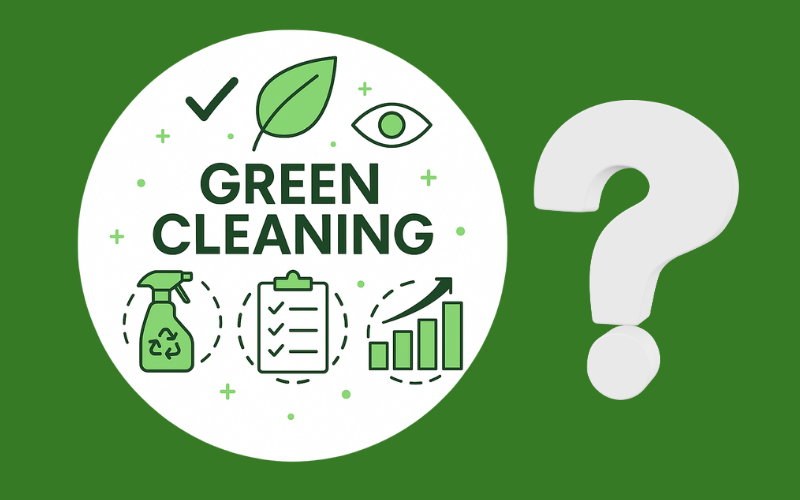
What the term means, the four certifications that prove a product is what it claims, why “eco-friendly” on a bottle means nothing, and whether any of it cleans as well as the old stuff.
In Short
Green cleaning means cleaning a building with products and methods chosen to reduce harm to the people inside it and to the environment, without giving up how clean the building gets. The catch is that anyone can print “eco-friendly” on a bottle, because that phrase isn’t regulated and doesn’t mean anything on its own. What means something is a certification: EPA Safer Choice and Green Seal for cleaning products, EPA’s Design for the Environment label and UL ECOLOGO for disinfectants. Those programs review every ingredient, and they test that the product still works. This guide is for facility managers who want to know what they’re buying, how to check a supplier’s claim in about a minute, and where green cleaning stops and disinfection starts.
Ask ten cleaning companies if they do green cleaning and ten will say yes.
That’s the problem with the term. There’s no law that stops anyone printing “green,” “eco-safe,” or “environmentally friendly” on a label, and the EPA says so directly. It calls the practice greenwashing and warns purchasers to be careful with vague claims. So the useful question isn’t whether your vendor says they clean green. It’s what they can show you.
The good news is that checking is easy once you know what to look for, and it comes down to four labels.
What Green Cleaning Means
Green cleaning is the whole approach to cleaning a building with less harm: the products, the equipment, the training, and the cleaning procedures and processes used in the act of cleaning, along with the decisions about where a strong chemical is needed and where it isn’t. Most people hear the term and think it’s only about swapping the cleaner in the bottle. The bottle’s part of it. It’s the smaller part.
A building where somebody swapped to a certified cleaner but still fogs the whole floor with disinfectant every night, uses no dilution control, and runs a vacuum with no real filtration isn’t cleaning green. It’s buying green and working the old way, because green cleaning practices also depend on product selection and energy efficient equipment, not just the bottle used.
What Makes a Product Green
The certification programs all look at roughly the same things, so this is a decent list of the following characteristics that green cleaners and cleaning solutions are supposed to have in a bottle:
- Lower volatile organic compound content than many commercial cleaning products, which supports indoor air quality by reducing what ends up in the air people breathe all day
- Fragrance-free, or a fragrance that meets the program’s criteria
- Choose biodegradable and non toxic cleaning supplies with low toxicity, because green cleaning products often contain biodegradable ingredients, so what goes down the drain doesn’t hang around
- Sold as a concentrate with dilution control, which cuts packaging, shipping weight, and the chance somebody mixes it wrong
- Recyclable or recycled-content packaging, with reduced packaging where possible, and a closer look at how a product is packaged and manufactured, including whether it has low life cycle energy
- Proven to work, tested against conventional products
That last one does more work than people expect, and we’ll come back to it.
The Four Labels That Mean Something
Here’s the part worth keeping. Two of these come from the EPA and two are third-party programs, and they split along a line most people miss: some certify cleaning products, and some certify disinfectants. They aren’t interchangeable.
| LABEL | WHAT IT CERTIFIES | WHAT IT TELLS YOU |
|---|---|---|
| EPA Safer Choice | Cleaning products: glass, general purpose, washroom, carpet, laundry. | Every single ingredient has been through EPA review for health and environmental effects, and the product has to perform. |
| EPA Design for the Environment | Disinfectants and sanitizers, which are antimicrobial products. | The product met federal pesticide registration and the same strict Safer Choice health and environmental criteria. This is the closest thing to a green disinfectant that exists. |
| Green Seal (GS-37) | Cleaning products for industrial and institutional use. | Independent nonprofit, science-based standard, with annual compliance monitoring rather than a one-time pass. Common in school and government requirements. |
| UL ECOLOGO | Cleaning products, and disinfectants, plus paper and liners. | Lifecycle testing across production, use, and disposal, against a published standard. |
If a vendor tells you their products are green, ask which of those four labels the products carry. It takes them ten seconds to answer if it’s true. Both EPA programs publish searchable product lists, so you can check the answer yourself.
The one-minute greenwashing test: pick up the bottle. If it says “eco-friendly,” “green,” or “environmentally safe” and there’s no certification logo, that’s marketing. If it carries Safer Choice, DfE, Green Seal, or ECOLOGO, somebody reviewed the ingredients and tested the performance. That’s the whole test. It’s the difference between a claim and a check.
Checking a vendor’s answer? We run EPA Safer Choice products as the default across NYC facilities and keep the product records to prove it. Call 212-929-7872 or get an estimate.
Green Cleaning and Disinfecting Aren’t the Same Job
This trips up more facility managers than anything else on this page.
Disinfectants are pesticides. Federal law regulates them that way, which is why they carry an EPA registration number and why the label is legally binding. So a disinfectant can’t be Safer Choice certified, because Safer Choice is for cleaning products. That’s what the DfE label exists for: a disinfectant that meets the pesticide rules and the safer-ingredient criteria at the same time.
The other half is knowing when to reach for one at all. The EPA’s own guidance says to limit disinfectants to surfaces people are likely to contact, and points out that most general cleaning tasks don’t need one. Walls and floors don’t need a kill claim. Door handles might. Using a disinfectant everywhere, every night, is the opposite of green cleaning even if the product itself is certified, and it’s a fast way to put unnecessary chemistry into the air your occupants breathe. We go through where the line falls in our facility manager’s guide to disinfection.
Does Green Cleaning Actually Work?
Straight answer: yes, and it’s not a matter of opinion.
Performance testing is written into the certification standards themselves. To carry Green Seal, EPA Safer Choice, or ECOLOGO, a product has to be tested and shown to perform as well as or better than conventional products in its category. A cleaner that doesn’t clean can’t be certified. So the old objection, that green products are the ones that don’t work, describes the uncertified stuff with a leaf on the label, which is exactly what a certification is designed to filter out.
Where the doubt comes from is real, though. Early green products in the 2000s were worse, and a lot of facility people got burned once and never went back. The standards have moved a long way since then. We source exclusively EPA Safer Choice certified cleaning products, 96% of the chemicals we use are eco-friendly, and we only use disinfectants on EPA List N. Nobody on our crews is fighting a product that won’t cut grease.
Why It Matters in a NYC Building
The health argument lands harder in this city than most, because of how buildings here work. Sealed envelopes, mechanical ventilation, high occupant density, and people spending nine or ten hours a day inside. Whatever goes into the air stays in the air longer than it would in a low-rise with windows that open. A Midtown tower where the windows haven’t opened since it was built holds onto what you clean with in a way a suburban office park never does.
The people carrying the most exposure aren’t the tenants. They’re the cleaners, working with these chemicals every shift, often in small rooms without much ventilation. Harsh products mean skin and respiratory problems for the crew first, and asthma triggers for occupants second. Common toxic chemicals in conventional products include ammonia, chlorine, and phosphates. That’s the honest reason to care about this beyond the certificate on the wall.
Tenants ask about it now too. Green cleaning practices show up in leases, appeal to eco-conscious customers, support occupant well being in dense buildings, and factor into tenant satisfaction and credits for buildings pursuing LEED. And for schools it stops being a preference and becomes law. We run the same green standard across Manhattan, Brooklyn, Queens, the Bronx, and Staten Island, because a product that’s right for a Midtown office is right for a Bronx charter school too.
Is Green Cleaning Required?
Depends entirely on your facility type. New York State requires schools to use approved green cleaning products, and the rules differ for public, charter, and private schools. Offices, warehouses, and most commercial buildings have no green cleaning mandate, though they carry other obligations.
Rather than half-explain it here, we’ve laid out which requirements apply to which facility type, with the documentation each one needs, in our NYC facility compliance guide. If you run a school or a mixed portfolio, start there.
Green Cleaning Is a System, Not a Shopping List
Products are where it starts. The rest is how the work runs.
Dilution control, so the crew isn’t eyeballing concentrate into a bucket and using four times what the job needs. Microfiber, which lifts soil with less chemical and less water, and can reduce bacteria by 99% compared to cotton. That kind of material choice supports better product selection for indoor air quality and dust control. Vacuums with real filtration, so what you pick up stays picked up instead of going back into the room. Entrance matting, which is unglamorous and keeps more dirt out of a building than any product will. Training, so people know which surfaces need what. And the discipline to use a disinfectant where it’s warranted and a cleaner everywhere else. Many effective cleaning solutions come from a typical pantry, and green cleaners like baking soda, vinegar, and salt handle a lot of everyday jobs. Castile soap works as a vegetable-based all-purpose option, while lemon juice and white vinegar help cut grease, deodorize, disinfect, and baking soda adds a gentle abrasive for stains.
That’s why we run green products as the default rather than an upgrade, and why the method sits inside our quality system instead of in a brochure. If you want the corporate side of it, our sustainability commitments cover energy, water, waste, and carbon, and about us covers who runs the company.
One thing to watch for in 2026: in 2024 the EPA added a Cleaning Service Certification to the Safer Choice and DfE Standard. It recognizes cleaning companies that use Safer Choice certified products for cleaning and DfE certified products for disinfection, either exclusively or as far as practicable. It’s new and few contractors have it yet, but it’s worth knowing the program exists, because it moves the conversation from what a vendor says about their products to what somebody verified about their operation.
Want green cleaning that holds the standard?
We run EPA Safer Choice products as the default across NYC facilities, with the documentation to show what was used and where.
Get An estimate
We will contact you within the hour to start working on your quote.
Your contact information
Sources
- U.S. EPA, Identifying Greener Cleaning Products (Safer Choice, DfE, greenwashing guidance). epa.gov
- U.S. EPA, Safer Choice and Design for the Environment Standard (performance criteria; Cleaning Service Certification). epa.gov
- U.S. EPA, Safer Choice certified product search. epa.gov
- U.S. EPA, DfE-Certified Disinfectants. epa.gov
- Green Seal, Standards (including GS-37 for industrial and institutional cleaners). greenseal.org
- UL Solutions, ECOLOGO Certification.