In short: Disinfection kills the specific germs named on an EPA-registered product’s label, using that product for its full contact time. It is the step beyond cleaning, which removes dirt and lowers germ counts but does not kill on a claim; disinfection is meant to reduce or kill harmful microorganisms on surfaces, including bacteria, viruses, and fungi. This guide is written for facility managers and directors of facilities running offices, schools, warehouses, and other commercial buildings. It covers the two modes of disinfection, preventive and reactive, the federal, state, and city rules that govern them, how the work changes by building type, and the process step by step. It matters because a defined, documented disinfection program can significantly reduce the risk of spreading infection in commercial buildings, keep one sick person from becoming six, keep you ready for an audit, and give you a plan for the day an outbreak lands.
What Is Disinfection?
Disinfection is the part of facility cleaning people talk about the most and understand the least. Most picture someone spraying a surface and wiping it a second later. That is not disinfection. That is wiping. Real disinfection is a program with two jobs: reducing pathogenic microorganisms in day-to-day operations, and shutting an outbreak down fast when one shows up.
If you run a building, your job is not to hold the sprayer. Your job is to decide what disinfection means in your facility, put it on a schedule you can point to, and have a plan ready for the morning three people call in sick with the same thing. This guide covers both jobs, what the rules actually require at the federal, state, and city level, how the work changes by building type, and the process we use to run it.
First, A Clarification of Three Important Terms and Their Definitions
Cleaning, sanitizing, and disinfecting are three different jobs. Getting them straight is the whole foundation, because a lot of money gets spent disinfecting surfaces that were never cleaned, which barely works.
Cleaning means physically removing soil first
Removes dirt, grease, and most germs from a surface using soap or detergent and water. It lowers numbers. It does not kill on a claim.
Sanitizing lowers the number of microbes
Lowers germs on a surface to a level public health considers safe. Common on food-contact surfaces. Less aggressive than disinfecting.
Disinfecting kills many pathogens on non-living surfaces
Kills specific pathogens named on an EPA-registered product’s label, when used at the right strength for the full contact time, but it does not necessarily kill all microbial forms, especially bacterial spores. By contrast, sterilization destroys all microbial life by physical or chemical methods, while high level disinfection sits between routine disinfection and that standard for some uses.
In short, disinfectant is not a shortcut for cleaning. Dirt, grease, body oils, and other organic matter can shield microbes and reduce disinfectant effectiveness on dirty surfaces, and these products can kill germs but do not remove germs by themselves the way cleaning does.
This is why the order matters: clean first, then disinfect if needed. If you reverse that order, you spend more product, get worse results, and create a false sense of safety.
So the routine commercial cleaning a building already gets is not separate from disinfection. It is the surface disinfection depends on. A facility that skips daily cleaning and tries to make up for it with heavy disinfecting is spending more to get less.
Preventive vs reactive: the two modes
Almost everything in a disinfection program falls into one of two buckets. Knowing which one you are in tells you the frequency, the product, and the paperwork.
| PREVENTIVE DISINFECTION | REACTIVE DISINFECTION | |
|---|---|---|
| What sets it off | A schedule. It runs whether or not anyone is sick. | An event: an outbreak, a confirmed case, a spill of blood or body fluids. |
| How often | Daily to weekly, set by traffic and risk. | A surge. Higher frequency for as long as the risk lasts, then back to baseline. |
| What gets treated | High-touch surfaces and restrooms across the building. | The affected area plus every shared surface people passing through would have touched. |
| Product | A standard EPA-registered disinfectant matched to the setting. | A product proven against the specific pathogen, often from EPA’s outbreak lists. |
| The record | A routine log: areas, product, frequency. | An incident record: what, where, which product, contact time, who was told. |
Most facilities live in the preventive mode and hope they never need the other one. That is the right instinct. A strong preventive program is what keeps a single sick employee from turning into six.
However, preventive disinfection is not guarantee and therefore we highly recommend having a plan and protocol in place in case of an outbreak.
What preventive disinfection actually includes
This is the mode you define and track, so it is worth being concrete. Preventive disinfection is not “spray the office”; it is a suitable routine for shared hard surfaces, and not every surface needs the same treatment. It is a named set of surfaces, on a named frequency, with a named product, written down in line with established guidelines.
Build the high-touch inventory
Walk the building and list every surface a lot of different hands touch in a day, including shared medical equipment where that applies to the building type. That list is the spine of the whole plan. In a typical office it looks like this:
- Door handles, push bars, and the plates around them
- Elevator buttons, both inside the car and on every floor
- Light switches and thermostat controls
- Shared keyboards, mice, phones, and copier and printer touchpads
- Faucet handles, flush handles, stall latches, and soap and towel dispensers
- Stair rails, break room appliance handles, and vending buttons
- Reception counters, sign-in tablets, and shared pens
Set frequency by risk, not by habit
A restroom in a 400-person building and a private office used by one person do not need the same touch. Match frequency to how many different people contact the surface and how vulnerable they are, since different products come in various concentrations, so the schedule and product choice have to be aligned. Restrooms, entrances, and shared kitchens earn daily disinfection in most buildings, while higher-risk buildings may need higher frequencies and, in some cases, higher concentrations only where the product label directs. A quiet back office might get it weekly. Cold and flu season, or a stomach bug going around, moves the whole schedule up for a while.
Match the product and respect the contact time
The most common disinfection mistake is not the wrong product. It is the right product used wrong. Every EPA-registered disinfectant has a contact time on the label, the number of minutes the surface has to stay visibly wet for the kill claim to hold. Wipe it off after ten seconds and you did not disinfect. You cleaned. Contact times run from about one minute up past ten depending on the product and the pathogen, so the product you pick and the way your crew is trained have to line up. Suitable actives include alcohol solutions with at least 70% isopropyl alcohol and hydrogen peroxide, and when label directions are followed they can kill bacteria, with alcohol-based disinfectants covering a wide spectrum of bacteria and the latter offering a less toxic option that is also effective against bacteria and viruses. This is not a suggestion on the label. Under federal pesticide law the label is the law.
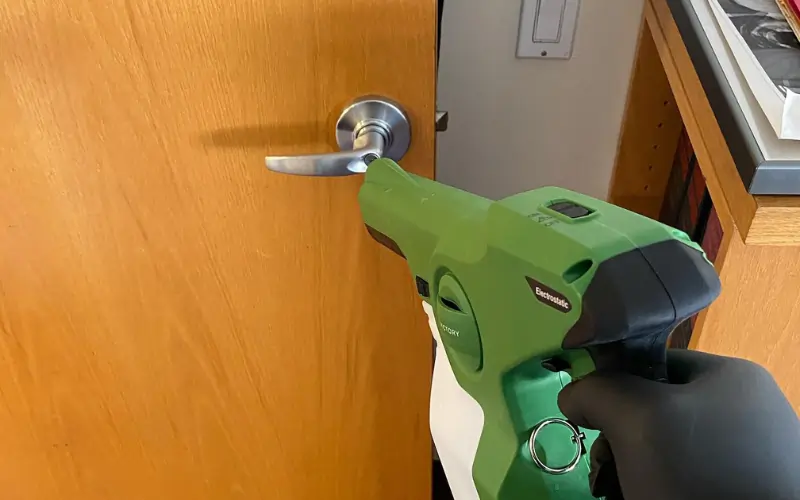
Important, since we get asked: fogging or misting an entire office every single night, with no one sick and no reason, is mostly theater. It looks thorough. It photographs well. But targeted disinfection of the surfaces people actually touch, done on a real schedule with the right contact time, protects a building better than a nightly fog of the air and the tops of filing cabinets nobody has touched since 2019. Save the whole-room electrostatic work for when it earns its place, which is an outbreak.
Write it down, or it did not happen
The plan is only real if it leaves a record. A basic disinfection log lists the areas, the product and its EPA registration number, the frequency, and a date and initial each time it runs. That log is what turns “we disinfect regularly” into something you can hand an auditor, a tenant, or a nervous parent. It is also how you find out a zone is getting missed before someone else does. This is the same reason our whole quality system runs on written records instead of a verbal “we handled it.”
How disinfection changes by facility type, including healthcare settings
The two modes stay the same everywhere. What changes is the risk profile, the frequency, and, for schools, the law. Compared with typical commercial buildings, health care settings have stricter disinfection and infection control requirements, so this article focuses on non-clinical facilities unless noted.
Office and corporate buildings
Offices are shared-surface environments: elevators, restrooms, kitchens, conference rooms, and reception. The risk spikes in cold and flu season and around big in-person weeks. A solid preventive plan on high-touch points, backed by daily office cleaning, carries most offices. The failure mode is treating disinfection as a one-time deep clean after someone gets sick instead of a standing routine.
Schools and charter networks
Schools carry the highest routine risk and the most specific rules. Kids touch everything, share close space, and are less careful about hygiene, so shared surfaces, desks, and restrooms need frequent attention. New York also regulates what goes on those surfaces. Under the state’s green cleaning law, Section 409-i of the Education Law, every public, charter, and nonpublic elementary and secondary school in New York has to use environmentally sensitive cleaning products from the approved list kept by the Office of General Services. Here is the nuance that catches people: that law governs cleaning and maintenance products, not disinfectants. Disinfectants are pesticides registered federally by the EPA, and schools still use them where disinfection is genuinely needed. So a compliant school program pairs green cleaning products for everyday cleaning with EPA-registered disinfectants for the surfaces and situations that call for a kill claim. We break down the schools mandate in detail in our NYC green cleaning regulation guide, and the wider picture in our piece on school cleaning.
Warehouses, distribution, and industrial
Fewer shared surfaces than an office, but the ones there are get heavy use: time clocks, break rooms, forklifts and shared equipment controls, and restrooms serving large crews on tight shifts. Disinfection here is targeted at those shared touchpoints rather than the vast floor. Our warehouse cleaning work usually pairs high-touch disinfection with the floor and degreasing work these buildings actually need day to day.
High-traffic public buildings
Attractions, cultural venues, and multi-tenant lobbies push huge numbers of strangers past the same doors, rails, and restrooms in a day. Volume is the risk. These buildings often need day-through disinfection of the highest-touch points, not just an overnight pass, which is where our NYC day porter services earns its keep.
The rules: federal, state, and city
No single agency owns facility disinfection. It sits under a stack of them. You do not need to be a compliance lawyer, but you should know what each layer requires so nothing surprises you in an audit. In healthcare settings, these rules are often interpreted through infection control and hospital epidemiology guidance alongside EPA and OSHA requirements.
| LEVEL | WHO AND WHAT | WHAT IT MEANS FOR YOU |
|---|---|---|
| Federal | The Environmental Protection Agency registers every disinfectant under federal pesticide law. OSHA’s Bloodborne Pathogens standard and Hazard Communication standard govern blood cleanup and chemical safety. | Use only EPA-registered disinfectants, exactly to label and contact time. Keep a Safety Data Sheet for every product. Handle blood and body fluids with an appropriate disinfectant after cleaning. |
| State | New York’s green cleaning law (Education Law Section 409-i) for schools; the State Department of Health for public health matters. | Schools use OGS-approved green cleaning products for cleaning, and EPA-registered disinfectants where disinfection is needed. Two rules, not a contradiction. |
| City | NYC Health Department health code, NYC Sanitation rules for chemical and waste disposal, and city school cleaning standards for public buildings. | Dispose of chemicals and any contaminated waste to city rules. Meet city standards for public and institutional buildings on top of the state and federal floor. |
For outbreaks specifically, the EPA runs a system worth knowing. Through its Emerging Viral Pathogens guidance, the EPA keeps pathogen-specific lists of registered disinfectants, List N for the virus that causes COVID-19 and List Q for emerging viral pathogens more broadly. Major guidance in healthcare epidemiology and the American Journal of Infection Control often shapes how facilities interpret practice, even though commercial buildings still follow EPA label law. When an outbreak hits, you match the product to the list for that pathogen rather than guessing.
Health and safety: disinfecting without creating new problems
Disinfectants are pesticides. Used right, they protect a building. Used carelessly, they trade one health problem for another, which is the whole reason the rules exist and the reason we treat the safety side as seriously as the cleaning side. Here are the concerns worth keeping in front of you, and how to control each one.
| CONCERN | WHY IT MATTERS | HOW TO CONTROL IT |
|---|---|---|
| Respiratory irritation | Sprayed or fogged disinfectant can trigger asthma and irritate airways, hardest on children and staff with conditions; repeated exposure to Quaternary Ammonium Compounds is also linked to occupational asthma. | Wipe rather than broadcast-spray for routine work, ventilate the space, and follow the label’s protective equipment. |
| Skin and eye contact | Concentrated disinfectant can burn skin and eyes and cause skin irritation. | Gloves and eye protection as the Safety Data Sheet specifies, and dilute exactly to the label. |
| Mixing chemicals | Bleach mixed with ammonia or acids releases toxic gas. | Never mix products. One disinfectant at a time, stored separately. |
| Indoor air quality | Overuse and heavy fogging leave chemical residue in the air people breathe all day. | Target high-touch surfaces. Keep whole-room fogging for outbreaks, not the nightly routine. |
| Vulnerable occupants | Children and sensitive people react more strongly to harsh chemicals. | Green cleaning products for routine cleaning, required in New York schools, and disinfect only where a kill claim is actually needed. |
| Wet surfaces and residue | Wet floors cause slips, and residue left on food or shared surfaces is its own hazard. | Signage while wet, let the surface dwell then dry, and rinse food-contact surfaces if the label directs. |
This matters most for healthcare workers, who face the most routine exposure to cleaning agents in healthcare settings, but the same discipline applies in any facility. Long-term exposure to disinfectants may also increase cancer risk, which is one more reason routine overuse is not a safe default.
The disinfection process, the way we run it
A repeatable process is what separates disinfection that works from disinfection that looks busy. Here is the sequence we follow on every job, preventive or reactive, and the same sequence applies whether you disinfect surfaces in offices, schools, or other non-clinical facilities.
Step 1. Map the surfaces
Start from the high-touch inventory for that building. You cannot disinfect what nobody wrote down.
Step 2. Match the product to the job
Pick an EPA-registered disinfectant proven against the pathogens that matter in that setting. Quaternary ammonium compounds are often found in disinfectant wipes and sprays, while chlorine-releasing agents are effective sporicidal, bactericidal, and virucidal agents when broader claims against most viruses are needed. Low-level disinfectants kill most vegetative bacteria and some viruses, while intermediate-level products kill all microbial pathogens except bacterial endospores. In an outbreak, that means the right EPA list for the pathogen.
Step 3. Clean first
Remove soil, grease, and other organic matter before any disinfectant goes down, because disinfectants do not work well on dirty surfaces when soil blocks contact. Skipping this essential step is the quiet reason disinfection fails, since disinfectants kill germs but do not clean the surface for you.
Step 4. Apply and hold the contact time
Keep the surface visibly wet for the full time on the label. This is the step most crews rush, and rushing it undoes the whole thing.
Step 5. Choose the physical or chemical methods to fit the scope
Manual wiping for routine high-touch work as the disinfection method for that scope. Electrostatic application for large areas and outbreak response, where even coverage matters. Some larger jobs may also use chemical methods alongside equipment-assisted application, but compliance still depends on the label.
Step 6. Document it
Log the product and its EPA number, the areas, the contact time, and the date. The record is part of the job, not an afterthought.
Step 7. Verify
A supervisor checks that the plan ran as written and corrects anything that slipped. Then the cycle repeats.
When there is an outbreak: the reactive protocol
This is the plan you hope to never run and cannot afford to improvise. When a confirmed case or an outbreak lands, speed and sequence both matter because the goal is to contain contamination and lower the chance of hospital infection or other facility-based spread where applicable.
- Isolate the area. Close or restrict the affected space so you are not disinfecting around a crowd.
- Escalate frequency. Move the affected zone and shared paths to a surge schedule for the length of the risk.
- Switch to the right product. Match the disinfectant to the pathogen using the EPA’s outbreak lists. When relevant to the setting, outbreak response should also account for resistant organisms such as pseudomonas aeruginosa. A general cleaner is not enough here.
- Go wide where it counts. Electrostatic application covers large or complex spaces evenly and fast, which routine wiping cannot.
- Handle body fluids to the standard. Any blood or body-fluid cleanup follows OSHA’s bloodborne rules: personal protective equipment as directed by OSHA and the product label, clean first, then an appropriate EPA-registered disinfectant for the full contact time.
- Document the incident. Record what happened, where, which product, the contact time, and who was notified.
- Communicate and return to service. Tell the people who need to know, then bring the space back once the work is verified and occupants are protected from spreading infection.
For a full reset after a bad outbreak, this is where routine disinfection hands off to a deep cleaning, and where an outside team that provide professional disinfection services at scale, takes the weight off your staff on a day they already have enough to deal with.
Building a disinfection program you can stand behind
Pull it together and the facility manager’s job comes down to three things, in plain terms. Define it: a written plan naming the surfaces, the frequency, and the products. Track it: a log that proves the plan ran and shows you where it did not. Be ready: an outbreak protocol that already exists on paper before you need it, so the answer to “what do we do” is a document, not a scramble.
Do those three and disinfection stops being a source of worry. You can tell a tenant exactly what you do. You can answer an auditor without digging. And when someone does get sick, you are running a plan instead of guessing. That is the whole point of treating disinfection as a program rather than a spray bottle.
Professional Disinfection SERVICES · NYC
Want your disinfection plan defined and documented?
We build preventive disinfection programs for NYC facilities, and we run outbreak response when it counts. Written plans, the right products, and a log you can hand anyone.
Get An estimate
We will contact you within the hour to start working on your quote.
Your contact information
SOURCES:
- U.S. EPA, Emerging Viral Pathogen Guidance and Status for Antimicrobial Pesticides.
- U.S. EPA, Disinfectant Use and Coronavirus (COVID-19), List N.
- U.S. EPA, Disinfectants for Emerging Viral Pathogens (EVPs), List Q.
- OSHA, Bloodborne Pathogens Standard, 29 CFR 1910.1030, and Quick Reference Guide.
- New York State Office of General Services, Green Cleaning Policies and Guidelines (Education Law Section 409-i).
- New York State Office of General Services, Green Cleaning Frequently Asked Questions (schools, Education Law Section 409-i). ogs.ny.gov
- OSHA, Respirator Cleaning Procedures (Mandatory)