In Short
The five levels of clean, which one to aim for, what it costs to move up, and how NYC facility managers use them to set expectations, staff, and defend a budget.
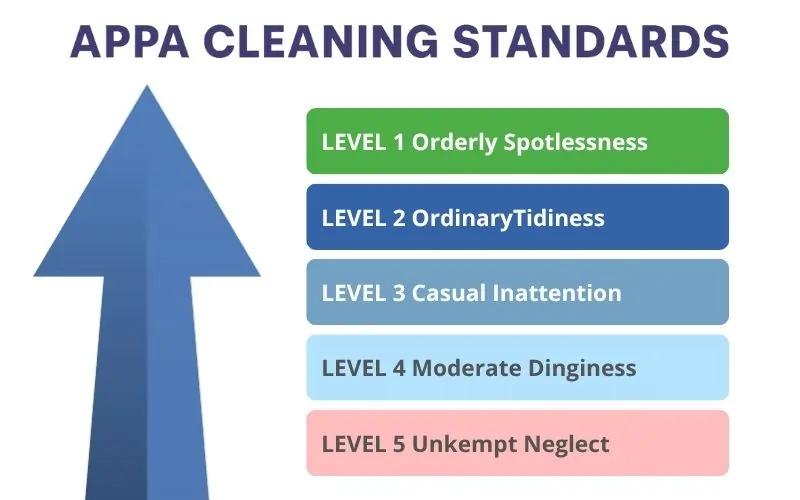
APPA cleaning standards are a five-level scale for rating how clean a building is, from Level 1, orderly spotlessness, down to Level 5, unkempt neglect. They were built for schools and campuses and are now used across healthcare, government, and commercial buildings. The point is a shared language: two people walking the same hallway should land on the same score. NYC facility managers use the levels to set expectations, size custodial staffing against square footage, and defend a cleaning budget with something better than “it looks dirty.” This guide covers the five levels, which one to aim for, what it costs to move up, and how to run an inspection that holds the standard.
If you run buildings in NYC, you’ve probably been told to keep one at Level 2. It sounds exact. It isn’t, not until everyone agrees on what Level 2 looks like.
Two people can walk the same corridor and score it differently, because the standard describes how clean a space looks, not a number on a meter. That’s the whole reason APPA exists. It turns “looks clean” into a scale everyone rates the same way, which is what lets a school district, a property manager, and a cleaning contractor all mean the same thing when they say a building is clean.
What Are APPA Cleaning Standards?
APPA is short for the Association of Physical Plant Administrators, the group now called APPA: Leadership in Educational Facilities. It built the five levels for colleges and schools in the early 1990s and published them in its custodial staffing guidelines. The idea was plain. Describe each level of clean in observable terms, so anyone can rate a space and get the same answer.
The levels caught on well past campuses. Hospitals, government buildings, museums, and commercial offices use them now, because a clear yardstick beats an argument about whether the lobby is clean enough. The official criteria live in APPA’s custodial guidelines, but you don’t need the full manual to put the scale to work.
The Five APPA Levels of Cleanliness
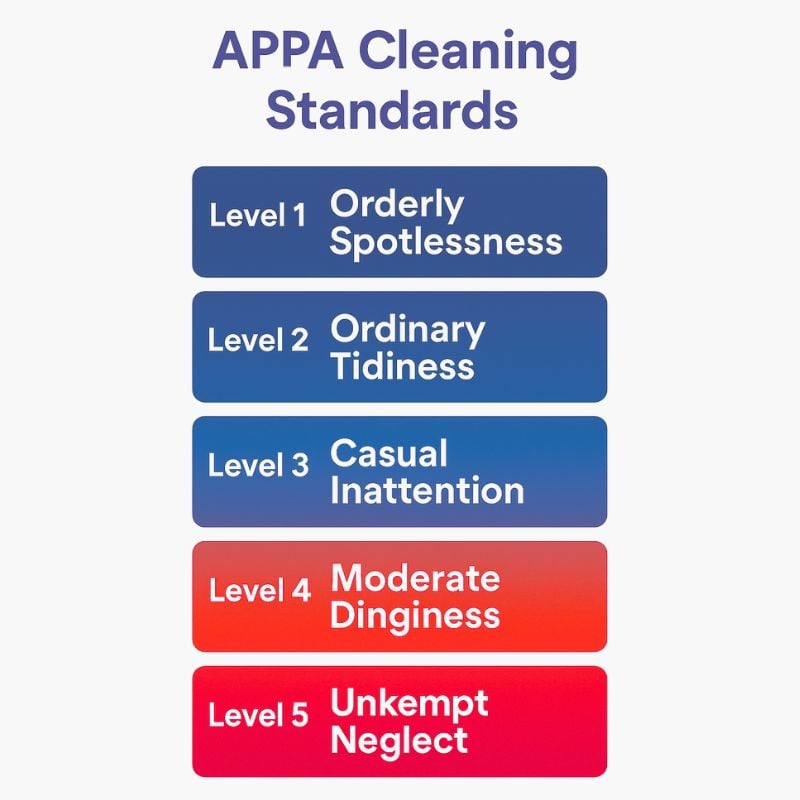
Here’s the whole scale, in plain terms. The point of the descriptions is that two inspectors looking at the same room should give it the same number.
| LEVEL | WHAT YOU SEE | WHERE IT FITS |
|---|---|---|
| 1 · Orderly Spotlessness | Floors bright and reflective, no dust on surfaces or ledges, fixtures spotless, nothing built up in corners. Looks freshly cleaned at all times. | Showpiece and high-risk areas: main lobbies, executive floors, patient areas, labs. |
| 2 · Ordinary Tidiness | Clean and well kept. Maybe a little dust in spots, but floors are clear, surfaces wiped, bins hold only the day’s trash. | The realistic target for most schools, offices, and institutional buildings. |
| 3 · Casual Inattention | Noticeable now. Dust on ledges and light fixtures, some matted carpet, bins that sour if they aren’t emptied daily. | Busy, moderate-traffic areas on a tight budget. Livable. Nobody is impressed. |
| 4 · Moderate Dinginess | Clear neglect. Old trash, dust balls, dirty base molding, worn paths in the walking lanes, dull floor finish. | Usually a staffing or budget shortfall rather than a plan. |
| 5 · Unkempt Neglect | Dirty floors, full and smelly bins, surfaces stained top to bottom, matted carpet. Cleaning is missing or ignored. | Not acceptable for a public building. A red flag. |
Which Level Should You Aim For?
Most buildings should aim for Level 2. That’s the honest target for a school, an office, or an institutional building that wants to look cared for without paying for a showpiece.
Here’s the opinion part. Chasing Level 1 across a whole building is usually a waste of money. Most of a building doesn’t need it. What works better is Level 2 as the baseline, with Level 1 reserved for the areas that earn it: main entrances and lobbies, executive floors, and the high-risk spaces where clean is about health rather than looks, restrooms, cafeterias, patient areas, and labs.
Dropping below Level 2 carries a cost that never shows up on the cleaning invoice. An APPA and ISSA study of college students found that 88% got distracted by the lack of cleanliness at Levels 3 and 4, and 84% said Level 1 or 2 made the best environment to learn in. In a school that’s test scores and enrollment. In an office it’s tenant complaints and lease renewals. A building tells people how well the operation is run, and they read it below Level 2.
What Moving Up a Level Costs
Moving up isn’t just cleaning more often. It’s more skilled staff, more supervision, better documentation, and better equipment, and the cost climbs with each step. Facility managers use a rough multiplier to set the expectation before the budget conversation:
Staffing and Expertise
- Level 5 to 3 may require basic custodial training.
- Level 3 to 2 requires trained, experienced staff with strong procedural discipline.
- Level 2 to 1 demands specialized expertise, meticulous execution, and additional layers of supervision.
Supervision and Quality Control
- Advancing each level typically requires more oversight and managerial bandwidth.
- Level 1 environments often include dedicated cleaning supervisors, quality assurance techs, and performance-based inspections.
Technology and Reporting
- Level 3 and up often integrate digital inspection tools, checklists, and audit logs.
- Level 1 requires fully developed systems for time tracking, service verification, and performance metrics.
Equipment and Supplies
- Better equipment and more targeted cleaning solutions are needed to prevent buildup and maintain surface integrity.
Cost Factors
Costs increase with each level due to additional labor, training, equipment, and quality assurance. A general multiplier model:
- Moving from Level 5 to 4: 1.25x baseline cost
- Level 4 to 3: 1.5x
- Level 3 to 2: 1.75x
- Level 2 to 1: 2x or higher, depending on building type and service frequency
This makes APPA a practical tool for aligning expectations with budget realities. Facilities must weigh whether their operations and occupants warrant Level 1 orderly spotlessness, or if Level 2 or 3 provides acceptable efficiency and hygiene.
Treat those numbers above as a planning estimate, not a quote, since building type and service frequency swing them. The jump people underestimate is 2 to 1. It’s less about scrubbing harder and more about systems: dedicated supervisors, quality checks, and documented inspections that catch a slip before the client does. That’s what Level 1 is paying for as much as the cleaning itself: the proof.
Why APPA Standards Matter in NYC
New York City’s educational facilities, hospitals, and public buildings deal with immense foot traffic. Maintaining high standards for cleanliness is essential for:
- Student and staff well being
- Infection prevention in healthcare settings
- Public trust and institutional credibility
In NYC, where square feet are expensive and staffing must be efficient, the APPA framework helps identify areas that need attention and optimize cleaning efforts.
Application in Educational Institutions
We provide cleaning services for NYC’s public schools, private universities, and charter networks, using appa cleaning standards to ensure:
- Compliance with NYC Department of Education requirements
- Enhanced learning environments
- Clear communication of expectations between custodial staff and administration
Base molding, light fixtures, floor finish, and dust dirt on horizontal surfaces are all evaluated under APPA’s criteria, helping prevent matted carpet, dull path conditions, and build up that affects students and faculty alike.
Cleaning Standards in Healthcare Facilities
Hospitals and clinics in Queens, Brooklyn, and Manhattan rely on consistent, measurable cleanliness standards. APPA helps categorize cleaning areas by risk and set protocols for:
- Sanitizing washroom and shower fixtures
- Keeping vertical and horizontal surfaces odor free
- Ensuring waste containers hold only daily waste
- Preventing dust balls and dirt accumulation
How to Implement APPA Standards
1. Assess Your Current Cleaning Protocols
Identify your current APPA level by examining:
- Base molding
- Walking lanes
- Tile gleam
- Stains on carpets and surfaces
2. Set Clear Benchmarks
Determine whether you’re aiming for level 1 orderly spotlessness, level 2 ordinary tidiness, or a feasible mid-tier.
3. Train Your Custodial Staff
Use APPA’s definitions to ensure uniform expectations:
- Dust dirt removal
- Proper maintenance of waste containers
- Preserving floor finish and avoiding unkempt neglect
4. Monitor and Improve
Establish a scoring system to track appa scores, ensure adherence to cleaning protocols, and reduce old dirt and days worth of trash.
How to Run an APPA Inspection
An APPA inspection is a walk, not a hunch. The steps are simple:
- Group areas by space type. A restroom and an open office are each judged against their own kind.
- Walk each space and score it 1 to 5 against the level definitions, based on what you see.
- Photograph anything that pulls the score down. A photo ends the argument about whether it was a 2 or a 3.
- Log it and repeat on a schedule, so you’ve a trend instead of a one-time snapshot.
The aim is to replace “it looks fine” with a score anyone can repeat and defend. Run it a few times and the numbers settle down.
APPA and Staffing Efficiency
APPA guidelines help determine the number of custodians needed per square feet. NYC-based physical plant administrators use this to budget and justify staffing levels, reducing old trash, dirty surfaces, and obviously matted carpet conditions.
Avoiding Common Cleaning Pitfalls
- Don’t let waste containers smell sour—empty daily waste regularly.
- Regularly inspect shower fixtures and washroom areas.
- Address dull spots, build up, and dust balls in overlooked areas.
How to Run an APPA Inspection
An APPA inspection is a walk, not a hunch. The steps are simple:
- Group areas by space type. A restroom and an open office are each judged against their own kind.
- Walk each space and score it 1 to 5 against the level definitions, based on what you see.
- Photograph anything that pulls the score down. A photo ends the argument about whether it was a 2 or a 3.
- Log it and repeat on a schedule, so you’ve a trend instead of a one-time snapshot.
The aim is to replace “it looks fine” with a score anyone can repeat and defend. Run it a few times and the numbers settle down.
APPA and Local Compliance
Aligning with APPA in New York supports:
- Health code requirements
- State-level educational mandates
- NYC’s sustainability goals
The Role of Data
Documenting cleaning levels via digital tools and cleaning protocols lets NYC facilities set performance benchmarks. These tools can help identify patterns like:
- Dust accumulation on light fixtures
- Old trash in waste containers
- Erosion of floor finish in walking lanes
Commercial CLEANING SERVICES · NYC
Talk to Us About Your Cleaning Requirements
We serve office buildings, schools, attraction venues, and commercial facilities across NYC. Get an estimate and written scope within 48 hours. No obligation.
Request a Quote
We will contact you within the hour to start working on your quote.
Your contact information
How We Run to APPA in NYC
We run APPA-scored inspections across the NYC buildings we clean, from office towers to schools to institutional space. APPA gives us the yardstick. Our quality system is how we hold it: documented walkthroughs, scores by area, photos, and a supervisor sign-off before the client has to notice anything slipped.
That’s the difference between saying we clean to a high standard and proving it. APPA is the shared language for the target. The documentation is what shows we hit it week after week, which is the part most cleaning falls down on by Thursday. If you’re building a program from scratch, we walk through matching the plan to the building in our guide to creating a custom cleaning plan, and we tune it by facility, whether that’s an office building, a school, or a managed property.
Sources & Further Reading
- New York City Department of Education – Facilities Services
- CDC Environmental Cleaning and Disinfection Recommendations
- APPA, Cleaning Operations and the Operational Guidelines for Educational Facilities: Custodial. appa.org
- Cleanliness and Learning in Higher Education (APPA Center for Facilities Research and ISSA), reported by FacilitiesNet. facilitiesnet.com
- U.S. Department of Education, NCES, Planning Guide for Maintaining School Facilities (custodial workloads by space type). nces.ed.gov
FAQs – APPA Cleaning Standards
Worth reading
Construction Waste Drop-Off NYC: What Contractors Need to Know Before Project Turnover
In Short Construction waste removal is an important step in any renovation, tenant improvement, or…
Create Your Custom Cleaning Plan – Guide To NYC Facility Managers
Generic cleaning plans fail because even “similar” facilities have dramatically different usage, wear patterns, and…