
Estimated reading time: 13 minutes
Looking for a complete overview of construction cleaning — contractor evaluation, Manhattan site logistics, and the full regulatory compliance table? See our What Is Post-Construction Cleaning? A Project Manager’s Guide to Final Cleaning Before Handover. This article covers the planning logic behind the three phases specifically.
For scope, pricing, and how we run the work on your site, see our post-construction cleaning services.
Why Construction Cleaning Happens in Phases
The most common mistake on construction projects is treating construction cleaning as something that happens once the building is finished. Very few projects reach a point where every trade finishes on the same day. Painters are completing touch-ups while electricians adjust fixtures. Flooring contractors protect finished floors while millworkers install hardware. Owner-requested changes continue until the final walkthrough.
Trying to run one complete cleaning at this stage almost always produces re-cleaning, damaged finishes, and unnecessary schedule pressure. The cleaning plan should adapt to the project — not force the project to adapt to the cleaning schedule.
The three phases exist because construction sites are dynamic: Rough Clean, Final Clean, and Touch-Up Clean. In the post construction cleaning process, the first phase clears the way for the next two, and each stage has a different objective, a different crew composition, and a different relationship to what the trades are still doing. The right sequencing of all three is what moves a project from active construction to owner handover without unnecessary rework.
01
PHASE ONE
Rough Clean
Objective: Create a safer, more organized work environment while supporting the remaining construction trades.
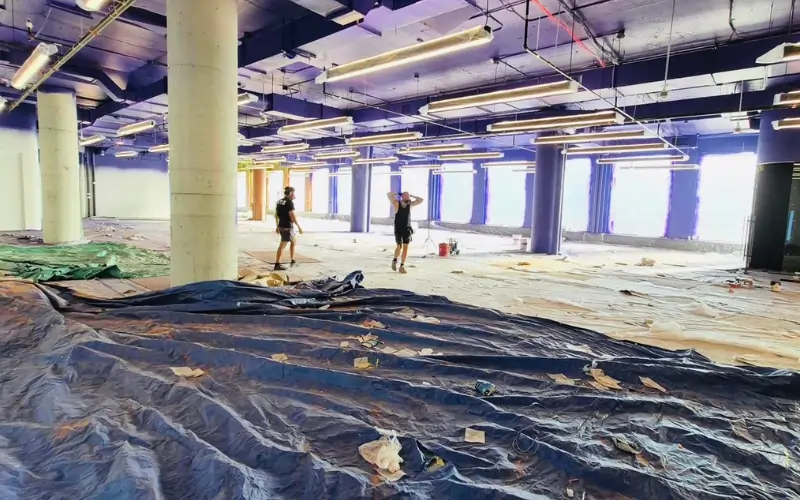
The rough clean begins while construction is still active. Appearance is not the priority at this stage — safety, site access, and trade productivity are. Typical activities include removing construction debris and scrap materials, collecting packaging, clearing walkways and work areas, improving access for remaining trades, and removing bulk dust accumulation where practical.
OPERATIONAL NOTE — WHAT PMS DON’T ALWAYS EXPECT
On a 200,000 sq ft Manhattan office project we ran last year, the rough clean turned up three areas where mechanical work had left debris behind ceiling tiles that nobody had flagged on the punch list. The superintendent hadn’t seen it because nobody goes above the tile line during a standard walkthrough. The cleaning crew did. That’s one of the less obvious values of getting a qualified cleaning contractor on-site during Phase 1 — they see things from the floor up, and they find problems before the detail clean crew has to work around them.
NYC COMPLIANCE — PHASE 1
DSNY §16-120— all C&D debris must be source-separated and removed by DSNY-authorized haulers. Unlicensed haulers create direct liability for the GC.
DOB §3303.7— egress routes must remain clear throughout. Non-compliance triggers inspection delays and potential stop-work orders.
NYC BIC— waste manifesting required for all C&D waste removal. See our NYC construction waste disposal guide
02
PHASE TWO
Detail Clean
Objective: Prepare completed areas in the construction zone for inspections, punch-list activities, and owner review.
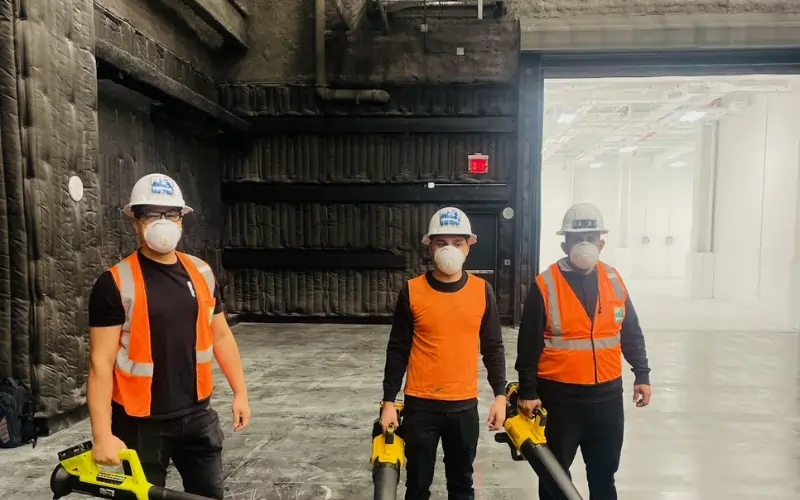
As areas become substantially complete, attention shifts from debris removal to surface work. This is the most labor-intensive phase — and the one most likely to generate rework if it’s sequenced incorrectly. Typical activities include detailed dust removal, cleaning windows and glass, cleaning doors, frames, and hardware, cleaning millwork and cabinetry, cleaning light fixtures, removing labels and adhesive residue, cleaning restrooms, cleaning HVAC grilles and diffusers, spot cleaning walls and finished surfaces, and making sure crews leave clean floors.
The sequencing challenge here is that trades are rarely fully out of a zone when the detail crew arrives. A quality contractor knows which areas are genuinely ready and which should wait — and makes that call independently rather than cleaning everything and relying on the PM to sort out the rework.
OPERATIONAL NOTE — THE HVAC SEQUENCING PROBLEM
We work zone by zone, floor by floor, confirming with the superintendent before the crew moves into any area. Once plumbing and electrical work is complete enough for cleanup to proceed, we start clearing large debris, construction trash, and leftover materials, while watching for hazards such as loose wires. If millwork is still active on the south side of a floor, we start on the north.
If the HVAC system hasn’t had its first run yet, we hold off on the grilles — because the first time the system runs on a Manhattan project, it redistributes heavy dust that’s been sitting in the plenum, and we’ll clean those grilles twice if we don’t sequence it right. That includes drywall dust that settles back onto finished surfaces, fine dust that keeps resettling after foot traffic, and other construction residue left behind by active trades.
On one recent project, the detail clean ran on floors 8 through 11 on Tuesday and Wednesday. The HVAC kicked on Thursday morning — first run since mechanical handoff. By Thursday afternoon every horizontal surface on those four floors had a visible dust layer. Owner walkthrough was Friday. The grilles hadn’t been touched. We went back in. That’s an entirely preventable outcome with one conversation about sequencing before the detail clean starts.
NYC COMPLIANCE — PHASE 1
OSHA 29 CFR 1926.1153— silica dust control; HEPA-filtered vacuums required for construction dust mitigation on active construction sites.
NYC Local Law 26— notification required for hazardous material use on commercial sites. Only MSDS-documented cleaning solutions permitted.
NYC DOB walk-throughs— surfaces must be adhesive-free and dust-free to pass. Adhesive residue on glass and hardware is one of the most common inspection flags.
03
PHASE THREE
Final Clean
Objective: Prepare the building for owner acceptance and occupancy.
The final clean — the touch-up clean stage — is the most misunderstood phase. It’s not one more cleaning — it’s a verification exercise as much as a cleaning operation. A systematic pass through every space in the building to confirm that what the detail crew did held up through the rest of the punch-list activity, and to correct anything it didn’t. This touch up cleaning is the detail-focused final pass before owner acceptance and helps make the space move-in ready for occupancy. Typical activities include final touch-ups, removing dust created during punch-list work, polishing finished surfaces, spot cleaning glass, final floor cleaning, mopping floors, and preparing the building for owner walkthroughs.
OPERATIONAL NOTE — VERIFICATION, NOT CLEANING
We run the final clean floor by floor, zone by zone, with the superintendent walking behind us at each sign-off point. Anything that doesn’t meet the standard gets corrected before we move to the next zone — not flagged and addressed at the end when the crew is packing up. The cost of finding something at the owner walkthrough is measured in schedule delay and relationship. The cost of finding it during the final clean is five minutes, and it’s what confirms a newly cleaned renovated space is ready for handover and makes the space move ready for the next occupant.
NYC COMPLIANCE — PHASE 1
DSNY §16-120— final debris removal must be documented. Proof of container usage required for final sign-off.
NYS DOH surface hygiene standards— high-touch surface disinfection with dwell-time products required for occupancy readiness.
NYC DOB final inspection— spotless common areas, functional HVAC, and compliant waste removal documentation required for Certificate of Occupancy sign-off.
Scheduling, Windows, and Crew Size — All Three
There’s a version of construction cleaning advice that says timing matters more than crew size. That’s wrong — and it’s the kind of thing that sounds reasonable until you’re actually running a closeout.
The handover date doesn’t move. You can’t add time. What you can do is negotiate a window — a zone that’s clear of active trades, a floor the superintendent has released, a two-day opening before the flooring installer returns. Every trade on the site is doing exactly this: the electrician, the plumber, the millwork crew. Everyone is working within windows that open and close based on what every other trade is doing. Construction cleaning is no different.
When a window opens, you move. That’s where crew size matters — not as a substitute for timing, but as the variable that determines whether you can complete the work before the window closes. A zone that clears on Wednesday afternoon with a DOB inspection on Friday morning requires enough crew to finish by Thursday evening. Four people who need three days aren’t a sequencing solution. The right answer is both: the coordination intelligence to know when the window is open, and the crew capacity to use it before it closes.
On a recent Manhattan closeout, a zone that had been blocked for three days cleared at 2 PM on a Wednesday. Owner walkthrough on that floor was Friday morning. We had the cleaning director on the phone with the superintendent by 2:15, four additional crew members on-site by 4, and the zone completed and signed off by 10 PM. That’s not a story about timing over crew size — it’s a story about having both ready at the same time. Without the coordination, we don’t know the window opened. Without the crew capacity, we can’t close it before Friday.
Reading The Schedule and The Site
The schedule is not the enemy — it’s the plan. It tells you where the project should be on any given day, which zones should be ready, and when each phase of cleaning should start. A cleaning contractor who doesn’t study the schedule before mobilising is already behind.
The problem is that the schedule describes the ideal world. What happens on site is the real world. As Mike Tyson put it: everyone has a plan until they get punched in the face. The punch, in construction, is the flooring installer who runs two days late, the punch-list team that returns to a zone you cleaned yesterday, the HVAC contractor who needs access to a floor the schedule said was yours today.
Reading the site means holding the schedule in one hand and reality in the other — knowing what was planned, seeing what is actually happening, and adjusting without losing sight of the fixed point that doesn’t move: the handover date. That means understanding:
Which floors are actually complete versus which are scheduled to be complete
Which trades remain active and where — and what dust or damage their remaining work is likely to generate
Where punch-list work is still running and which adjacent areas it will affect
Which areas should wait because cleaning them now means cleaning them again tomorrow
Which areas can move directly into the next phase without risking rework
The best contractors function as part of the project team during closeout — not waiting for instructions but feeding information upward. We’ve caught punch-list items during cleaning operations that the superintendent hadn’t seen. We’ve flagged floor protection pulled too early before the adjacent trade finished. We’ve identified HVAC sequencing issues during the detail clean that would have appeared as owner concerns at the final walkthrough.
None of that comes from ignoring the schedule. It comes from knowing the schedule well enough to recognize when the site has diverged from it — and being close enough to the project to act on that before it costs the PM time they don’t have.
Common Sequencing Mistakes During Construction Project Closeout
Most avoidable re-cleaning and closeout inefficiencies are not caused by poor cleaning — they’re caused by poor sequencing. Even an experienced cleaning contractor will struggle if work is scheduled before an area is genuinely ready. Industry guidance for commercial construction emphasizes work scheduling, job-site coordination, housekeeping, and protecting completed work as part of maintaining a clean project environment.1
Final cleaning before painters complete touch-ups
Paint touch-ups, hardware installation, caulking, and owner-requested changes often continue after an area appears complete. If final cleaning is performed before these activities finish, freshly cleaned surfaces frequently require additional cleaning before owner handover. The cleaning wasn’t the problem — the sequencing was.1
Cleaning before punch-list work is complete
Punch-list activities almost always bring trades back into completed spaces — electricians adjusting fixtures, painters completing touch-ups, millworkers replacing damaged trim, flooring contractors addressing minor defects. Every return visit introduces new dust, footprints, and construction traffic. For that reason, many commercial projects run a final touch-up clean immediately before the owner walkthrough rather than assuming one detailed cleaning will remain untouched.
Removing floor protection too early
Finished flooring should remain protected until heavy construction traffic has ended. Removing protection too early exposes finished surfaces to ladders, carts, tools, and material deliveries that create scratches, staining, or impact damage. Once damaged, repairs become additional punch-list items that delay turnover and increase project costs. The objective is to protect completed work until the building is ready for handover — not to finish cleaning as fast as possible.
Cleaning completed areas while adjacent trades continue generating dust
Heavy dust does not stay in one room. Drywall sanding, drywall dust, concrete cutting, wood trimming, ceiling work, and mechanical installation all generate fine airborne particles, and foot traffic can track dust and debris into adjacent spaces where they settle onto horizontal surfaces. Cleaning should follow completed work zones rather than operate alongside active dust-generating trades wherever practical.1
Scheduling crews from the calendar alone
A floor shown as complete on Tuesday may still have painters, punch-list work, inspections, or owner changes on Wednesday. The schedule is a planning tool — not a guarantee of site readiness. Experienced contractors assess actual site conditions each day and adjust crew size, priorities, and sequencing accordingly. That flexibility reduces unnecessary mobilisations and avoids paying to clean the same areas twice.
Not coordinating HVAC startup with the cleaning sequence
If HVAC systems are started before air ducts, ductwork, and occupied spaces have been fully cleaned and protected, residual construction dust redistributes through the ventilation system into recently cleaned areas. SMACNA recommends coordinating jobsite cleanup, work scheduling, and duct protection during construction, including cleaning or protecting duct runs before startup so dust is not redistributed.2 Poor sequencing can also undermine indoor air quality.
SOURCES
1. Sheet Metal and Air Conditioning Contractors’ National Association (SMACNA), Duct Cleanliness for New Construction Guidelines — sections on jobsite cleanup, work scheduling, temporary storage, and coordination between trades.
2. SMACNA, Duct Cleanliness for New Construction Guidelines — recommendations on HVAC startup, duct protection, temporary filtration, and scheduling during construction.
Summary
The three phases work when they’re sequenced correctly against the actual state of your project — not the original schedule.
For commercial projects in New York City, construction cleaning also operates within a defined regulatory framework — DSNY waste requirements, OSHA dust standards, DOB inspection readiness, and CO documentation. A contractor who doesn’t know this framework is a compliance risk as well as a scheduling risk.
See our construction cleaning services or contact us directly to discuss your project timeline and turnover requirements. For the complete project management framework — including contractor evaluation, Manhattan site logistics, and the full regulatory compliance table — see our What Is Post-Construction Cleaning? A Project Manager’s Guide.
post-construction CLEANING SERVICES · NYC
Tells us Your Construction handover date. We’ll Handle the Rest.
Project details, timeline, and scope — send us what you have. We’ll confirm availability, scope, and pricing within the same business day.
Request a Quote
We will contact you within the hour to start working on your quote.
Your contact information
Environmental Impact of Construction Cleaning
Advantage Cleaning is well-versed in federal, state, and municipal regulations for handling and transporting waste in the regions we operate. We assist construction project managers and general contractors with efficient and compliant waste sorting and transporting to improve their sustainability and minimize levies related to the transport and disposal of construction waste.
We provide you with the expertise covers handling both common construction & demolition debris, like masonry materials and wood, and hazardous wastes generated by construction activities, like paints, organic solvents, and used oil.
Construction projects generate a significant amount of waste, contributing to environmental concerns. However, by using environmentally friendly cleaning products and techniques, proper post-construction cleaning can play a vital role in reducing waste and lowering a project’s ecological footprint.
EPA: construction and demolition activities accounted for nearly 38.1% of total landfill waste
According to a report by the Environmental Protection Agency (EPA), construction and demolition activities accounted for nearly 38.1% of total landfill waste in the United States in 2018†. This alarming statistic highlights the urgent need for sustainable waste management strategies within the construction industry.
†U.S. Environmental Protection Agency (EPA). (2020). Sustainable Materials Management: Facts and Figures.
FAQ
Related articles
No post found!