
In Short
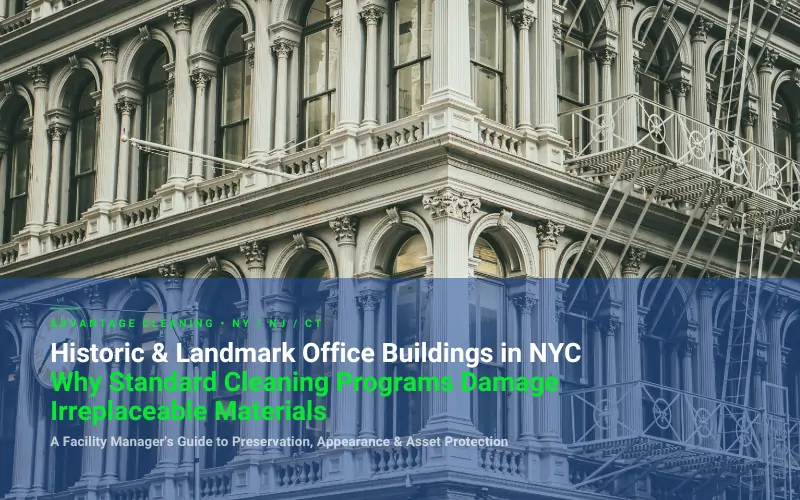
New York City has more than 38,000 protected landmark properties — including over 157 historic districts spanning all five boroughs. If your office building was built before 1950, there’s a reasonable chance it’s in one. That matters for cleaning because the materials in these buildings — marble, terrazzo, limestone, brass, bronze, decorative metals, historic woodwork — cannot be maintained with the same products and methods used in modern office towers. The wrong cleaning product on a marble lobby doesn’t just leave a mark. It can permanently damage a surface that costs more to restore than most facilities budget for in a year of routine cleaning.
More NYC Office Buildings Are Landmark Properties Than Most Facility Managers Realize
When most people think of landmark buildings, they think of the Chrysler Building or Grand Central Terminal. The reality is that landmark designation in New York City is far more common — and far more distributed — than that.
38,000+
Protected landmark properties in NYC
1,470
Individual Landmarks across the five boroughs
125
Interior Landmarks requiring preservation
157+
Historic Districts and Extensions
Source: NYC Landmarks Preservation Commission
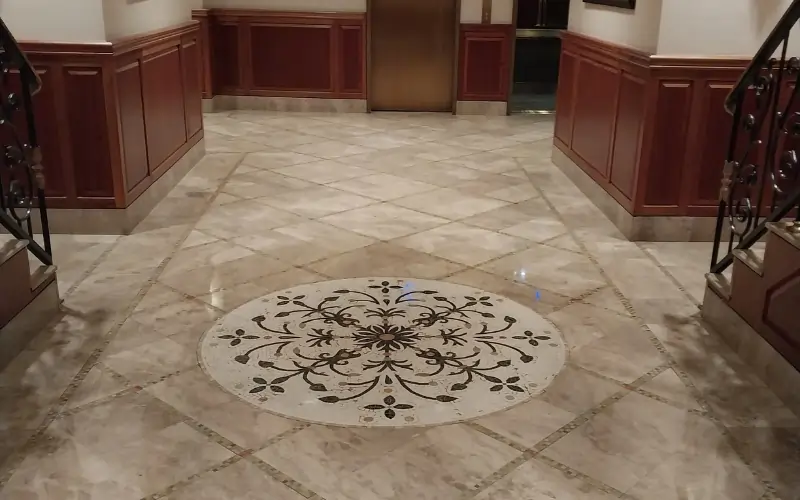
After image of cleaning and polishing marble floor in landmark office building in Manhattan NYC
A significant portion of Manhattan’s pre-war commercial stock — the office buildings between 1900 and 1950 that define the character of Midtown and Lower Manhattan — sits within historic districts or carries individual landmark status. We’ve worked in buildings where the facility manager didn’t know they were managing a landmarked interior until an LPC inspector raised a question about a proposed alteration to the lobby. The designation doesn’t always show up in a handover document.
If you manage a pre-war commercial building and have never verified its landmark status, it’s worth checking. The LPC’s designation database is the right starting point.
What Landmark Designation Actually Requires
Landmark designation is a legal status, not an honorary one. Building owners of landmarked properties are obligated to maintain designated architectural features in good repair and to seek LPC approval before making alterations that affect protected elements. Neglect that allows designated materials to deteriorate can trigger enforcement action.
For facility managers, this means understanding that maintenance decisions affecting protected materials carry implications beyond appearance. A marble lobby floor that deteriorates through deferred maintenance or improper cleaning isn’t just an asset problem — in a landmarked building, it can become a compliance problem for the building owner.
The operational distinction: a janitorial standard asks whether the surface is clean. A preservation standard asks whether the maintenance program is protecting the surface’s integrity over time. Those are different thresholds and require different programs.
NYC Landmarks Preservation Commission — Official Resources
Why Standard Cleaning Methods Damage Historic Materials
The materials in pre-war NYC office buildings weren’t designed for the cleaning products that became standard after the 1970s. Multi-purpose cleaners, acidic descalers, abrasive floor pads, and alkaline stripping chemicals — all routine in modern office cleaning programs — can permanently damage marble, limestone, brass, bronze, and historic woodwork.
We’ve walked into landmark buildings in Manhattan where marble lobby floors were being mopped with a multi-purpose cleaner that was chemically etching the surface on every cleaning cycle. Brass elevator surrounds polished with a product designed for stainless steel, leaving micro-scratches that accumulated into visible surface damage. Limestone wall panels cleaned with an acidic product that was dissolving the surface slowly enough that the damage wasn’t noticed until it had progressed significantly.
In every case, the cleaning crew wasn’t making a careless choice. They were using the products they had for the task they’d been given. The failure was in the program — a standard janitorial spec applied to materials that needed a preservation-first approach.
Historic materials — failure modes by surface
Marble & Natural Stone
Physically and chemically vulnerable
Dirt and grit under foot traffic act as abrasives. Acidic cleaners etch the surface chemically. Both failures accumulate invisibly until visible damage has already set in.
Etching from acidic cleaners is permanent — restoration requires honing (removing material), not polishing
Limestone
More porous and more reactive than marble
Staining that wipes off ceramic tile can become permanent on limestone within hours. Acidic products, abrasive methods, and excess moisture all cause irreversible surface erosion.
Standard multi-surface cleaners are acidic enough to damage limestone on every cleaning cycle
Terrazzo
Gradual gloss loss without a visible trigger
Terrazzo loses gloss slowly under traffic and improper maintenance. The floor looks progressively duller over years without any single incident you can point to.
By the time dullness is noticed, restoration is more disruptive and expensive than periodic polishing would have been
Architectural Metalwork
Elevator cabs, lobby panels, decorative grilles
Many pre-war Manhattan buildings contain architectural metalwork that contributes to their landmark significance. Abrasive products, wrong-pH cleaners, and excess moisture are the most common failure causes.
Finish degradation on a protected architectural element is both an asset and a compliance problem
Brass & Bronze
Each finish type requires different chemistry
Brass and bronze oxidize naturally. Pre-war architectural brass often carries a specific patina or lacquer that must be maintained — not simply polished to a bright finish. The wrong restoration approach on a protected element can create an LPC issue.
Stainless steel cleaning products cause micro-scratching on brass — common mistake, cumulative damage
Historic Woodwork
Lacquers and varnishes sensitive to moisture and chemistry
Pre-war millwork, paneling, and doors are typically finished with lacquers sensitive to both chemical exposure and moisture. Standard multi-surface cleaners can strip or cloud these finishes.
Excess moisture during cleaning causes swelling, warping, and adhesion failure in historic wood finishes
For facilities with multiple floor types, our Floor Cleaning Services programs combine daily maintenance with periodic restorative care appropriate to each surface.
Cleaning vs maintenance vs restoration
These are three distinct scopes. Confusing them is how deferred maintenance becomes a restoration crisis — and in a landmark building, a more expensive one.
Cleaning
Daily and weekly
Removes surface dirt, dust, and contamination without altering the material. In historic buildings, cleaning requires surface-appropriate products and methods — not more labor, but different chemistry and technique.
- Surface dirt and dust removal
- Correct chemistry for the material
- No alteration to surface condition
Preventive Maintenance
Periodic — scheduled
Preserves the material’s condition and finish over time. For marble, periodic professional polishing and inspection. For brass, controlled cleaning and protective treatments. The goal is to make restoration unnecessary.
- Surface condition preserved
- Deterioration caught early
- Restoration costs deferred indefinitely
Restoration
Reactive — after damage
Repairs damage that maintenance didn’t prevent. For marble: honing to remove damaged stone, then polishing. For brass: stripping oxidation and refinishing. Always more expensive and more disruptive than the preventive maintenance that would have made it unnecessary.
- Physical damage repaired
- Material removed or refinished
- Significantly higher cost than prevention
Many historic office buildings rely on periodic marble and natural stone maintenance to preserve appearance and avoid costly restoration projects. Learn more about our Marble Floor Cleaning & Restoration Services.
Preventive maintenance schedule — historic office buildings
The frequencies below are calibrated to landmark and historic buildings, where the preservation standard is higher than a standard commercial maintenance program. For general surface maintenance guidance across all NYC office buildings, see our deep cleaning and preventive maintenance schedule.
Preventive Maintenance Schedule — Historic & Landmark Office Buildings
NYC← Scroll to see all columns →
| Surface | What Accumulates Over Time | Recommended Intervention | Typical Frequency |
|---|---|---|---|
| Marble & natural stone | Surface dulling, chemical etching, micro-scratches from traffic abrasion | Stone-safe cleaning, diamond polishing, honing, crystallisation | Annual inspection; maintain as condition requires |
| Limestone | Staining, erosion from acidic products, moisture damage | Specialist stone cleaning and protective sealing | Annual — more frequently post-winter |
| Terrazzo | Gradual gloss loss, surface scratching | Professional polishing and restorative maintenance | Annual to semi-annual |
| Brass & bronze | Oxidation, tarnishing, finish type–specific deterioration | Controlled cleaning, polishing, protective treatment matched to finish type | Quarterly to annually |
| Architectural metalwork | Scratching, finish degradation, moisture and pH damage | Surface-specific cleaning and preservation protocol | Quarterly |
| Historic woodwork | Lacquer cloudiness, moisture damage, finish adhesion failure | Specialist wood cleaning and conditioning — low-moisture methods only | Annual |
| Entrance lobbies | Salt, sand, and moisture damage — intensified by NYC winters | Seasonal restoration and floor care appropriate to surface type | Post-winter and as condition requires |
Frequencies are calibrated to landmark and historic buildings where the preservation standard is higher than a standard commercial maintenance program. Actual intervals depend on traffic density, current surface condition, and prior maintenance history.
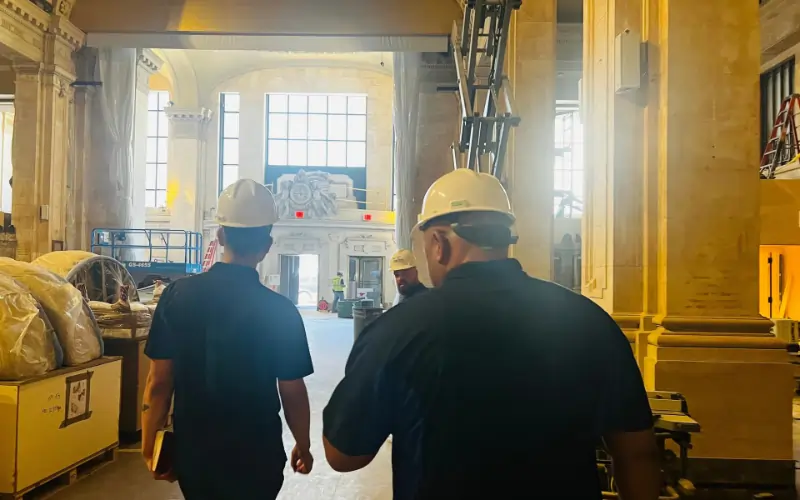
Advantage Cleaning crew during daily quality inspection of post renovation cleaning of historic building in Manhattan NYC
Historic office buildings still require the same daily cleaning fundamentals as any modern workplace. The difference is that every task must be adapted to the materials and preservation requirements of the building. Our Office Cleaning Services NYC programs are designed around those operational realities and supported by a Quality System to ensure both a consistent high-quality outcome, and correct and protective cleaning protocol.
The vendor coordination problem
Why historic buildings need integrated maintenance
The Vendor Gap – and Why It Matters
Most cleaning companies in New York City don’t maintain historic buildings. They maintain modern ones. The distinction isn’t about willingness — it’s about equipment, product knowledge, and the training required to work on surfaces where a wrong-product mistake isn’t recoverable.
The result is a vendor coordination problem that most facility managers in landmark buildings know well. The janitorial company handles routine cleaning. A specialty contractor handles marble maintenance. Another handles metal restoration. A third handles woodwork. None of them have visibility into what the others are doing. The marble contractor may not know the janitorial crew switched cleaning products last month. The janitorial crew may not know the brass was just treated with a specific lacquer that needs a different maintenance approach for the next 90 days.
We’ve been brought into historic office buildings specifically to consolidate this — daily cleaning, surface maintenance, and periodic restoration under one accountable program. When the same team that knows the building’s daily cleaning scope is also managing the marble maintenance schedule and the metal treatment calendar, nothing falls through the gap between contracts. For a historic or landmark building, that coordination isn’t a convenience. It’s a quality requirement.
Whether you manage a landmark office tower, a historic commercial property, or a mixed-use building, our Commercial Cleaning Services NYC programs are designed to protect both the facility and the materials that make it unique. We work across Manhattan, Brooklyn, Queens, the Bronx, and Staten Island, and we know what it means to maintain a building where the materials aren’t replaceable.
CommerciaL CLeaning Services · NYC
Commercial Cleaning That Runs Without Constant Follow-Up
For facility managers who need consistency, accountability, and documented execution across every shift.
Supervisor-led quality control · Site-specific cleaning plans · KPI reporting & inspections · Single point of accountability
Request a Quote
We will contact you within the hour to start working on your quote.
Your contact information
Historic Building & Landmark Cleaning
Frequently Asked Questions
Worth reading
Deep Cleaning & Preventive Maintenance Guide for NYC Offices
In Short Most NYC office buildings have a daily cleaning program. Most don’t have a…
Office Cleaning: A Facility Manager’s Guide to Maintaining a Professional Workplace
In Short A clean office isn’t the goal. A professional workplace is. The difference matters…
NYC Office Building Sanitation & Disposal Rules – for Facility Managers
In New York City, commercial office buildings face strict Department of Sanitation (DSNY) and Business…