
In Short
A school that passes Monday’s walkthrough but fails by Friday afternoon has a systems problem, not a staffing problem. This guide covers what a school cleaning program should actually produce — for students, teachers, parents, and the facility director managing the budget behind all of it — and how to evaluate whether yours is doing that job.
School Cleaning Is a Facility Management Problem, Not a Custodial One
Facility directors know this. The people who write cleaning specs often don’t.
The objective of a school cleaning program isn’t to check tasks off a list. It’s to create an environment where students can focus on learning, teachers don’t start the day dealing with facility complaints, and the building’s assets — floors, restrooms, cafeterias, gyms — last as long as the maintenance budget needs them to.
We work with charter schools, private schools, and public school facilities across NYC and NJ — Bronx campuses with 600 students moving through four restroom banks six times a day, Brooklyn charter schools where the facility director is also the operations manager, Queens buildings running three shifts of students through a single cafeteria. The cleaning problem in each one is different. The standard behind it isn’t.
When a school’s cleaning program is working, nobody talks about it. When it isn’t, everyone does — students, teachers, parents, and the principal who now has a facilities complaint on their desk at 8 AM.
Every School Serves More Than One Stakeholder
One mistake vendors make is scoping a school cleaning program around the building. The building isn’t the customer. It serves five different groups with different definitions of what “clean” means.
| Stakeholder | What They Care About |
|---|---|
| Students | A comfortable environment that doesn’t distract from learning |
| Teachers | Classrooms ready for instruction when they walk in |
| Parents | Confidence that the school is well managed |
| School leaders | Reputation, operational outcomes, compliance |
| Facility directors | Standards, asset preservation, and budget control |
The same hallway means something completely different to each of them. A student sees a corridor. A parent visiting for a school event sees whether the school feels maintained. A facility director sees flooring life expectancy, maintenance costs, and a capital replacement timeline. A cleaning program that only serves one of those perspectives is leaving the others exposed.
The Spaces That Shape Perception Most
Not every area carries equal weight. These are the ones that define how people experience the school.
Entrances.
Parents begin evaluating a school before they reach a classroom. A clean, well-maintained entrance signals that the building is managed. A neglected one signals the opposite — and that impression is hard to reverse. We’ve seen parents raise facility concerns in enrollment conversations that started at the front door.
Restrooms
The single most discussed space in any educational facility. Students notice them. Teachers notice them. Parents notice them at events. Restrooms don’t need to be luxurious. They need to feel like someone is paying attention to them — not just at 6 AM after the overnight crew, but at 11 AM when three hundred students have cycled through.
Classrooms
Where the school’s mission actually happens. Teachers should start the day focused on students, not on the fact that the floor wasn’t mopped or the whiteboard wasn’t wiped. A classroom that isn’t ready isn’t a minor inconvenience — it’s friction at the exact moment you can least afford it.
Cafeterias and common areas
These spaces take more daily abuse than anywhere else in the building and tend to show it fastest. They’re also the spaces that determine whether a school holds its standard throughout the day or loses it by noon.
Gym floors
A significant capital asset in most schools. Deferred maintenance on a gym floor doesn’t show up immediately — it shows up in the restoration quote two years later. A wood gym floor that’s properly maintained and refinished on schedule will outlast one that’s cleaned reactively by a decade.
School Cleaning Is Asset Management
Facility directors understand this even when school leaders don’t. Cleaning is one of the primary levers that determines how long a building’s assets last and what it costs to maintain them.
| Asset | Why It Matters |
|---|---|
| VCT flooring | High replacement cost, heavy daily traffic, maintenance-cycle dependent |
| Gym floors | Significant refinishing expense; proper care extends life by years |
| Carpets | Indoor air quality, appearance, and replacement timeline |
| Cafeterias | Constant wear, grease accumulation, high maintenance demand |
| Restrooms | Continuous use, grout and fixture degradation, perception impact |
| Entrances | First impressions, accelerated floor wear from foot traffic and weather |
Every year a floor stays in service before replacement represents real budget value. Every restoration project that gets postponed through proper maintenance is capital expenditure deferred. The schools that manage cleaning as asset preservation spend less on capital projects over a five-year horizon than the schools that treat it as a daily task list.
Learn more about how structured floor maintenance cycles work in our commercial floor cleaning services guide, including VCT floor strip and wax service specific to VCT floors.
How Do You Know If a School Is Actually Clean?
Ask ten teachers if a school is clean and you’ll get ten different answers. Ask ten parents and you’ll get ten more. That’s the problem with relying on opinions as the measure of a cleaning program.
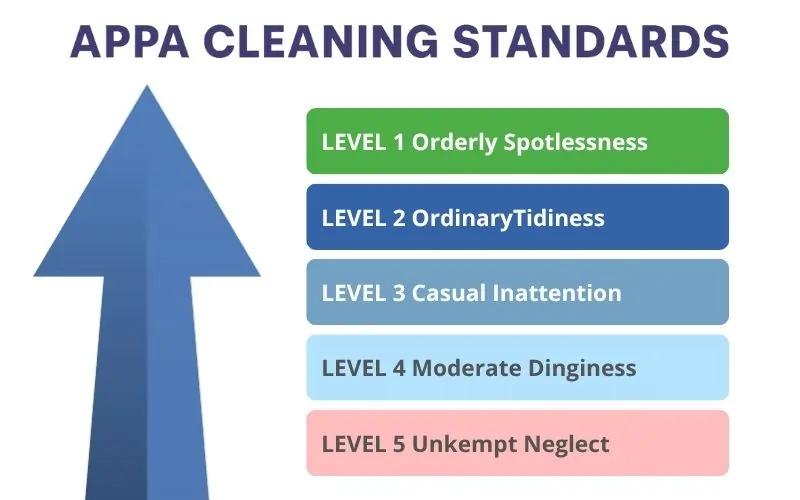
The most effective educational facilities use APPA Cleaning Standards to define and measure cleanliness rather than leaving it to subjective assessment. APPA provides a common language — Level 1 through Level 5 — that lets facility directors, custodial staff, and administrators discuss expectations, staffing, and budgets against a defined framework rather than a feeling.
Most NYC schools we work with target Level 2 or Level 3 depending on facility type, occupancy, and budget. The target matters less than the fact that everyone agrees on what it is before a complaint gets filed.
NYC schools also operate under specific facility maintenance requirements from the DOE. See our guide to NYC school facility maintenance mandates for what those standards require and how to stay ahead of them.
Educational facilities may also be subject to green cleaning requirements and other operational obligations. See our NYC Facility Compliance Guide for additional information.
The School Cleaning Calendar
The biggest mistake in school facility management is planning cleaning one day at a time. A school in October has different needs than a school in July. The programs that work are built around cycles, not daily task lists.
Daily — Maintaining standards. Classrooms, restrooms, cafeterias, entrances, and common areas. This is the baseline that keeps complaints from accumulating. It has to be consistent — not excellent on Monday and invisible by Thursday.
Weekly — Evaluating recurring issues, inspecting problem areas, and addressing accumulation before it becomes visible. High-touch surfaces, restroom grout lines, entrance floor conditions, cafeteria corners. What the daily crew doesn’t reach, the weekly review catches.
Monthly — Floor condition review, deep cleaning needs assessment, and performance evaluation against standards. This is when facility directors should be asking whether the program is holding or slipping — not waiting for a complaint to tell them.
Winter break — One of two major maintenance windows. With students out and classrooms accessible, winter break is the right time for deep cleaning projects, floor maintenance, and detailed work that can’t happen during instruction. Schools that skip this window arrive at the second semester behind.
Summer break — The most important facility maintenance period of the year. Not a cleaning season. A facility reset.
Summer Reset: The Season That Determines How the Year Starts
Ask facility directors when the most important cleaning period is and most won’t say September. They’ll say July.
With students gone and every space accessible, summer is the window for the work that drives building condition for the entire academic year. We’ve seen schools come back in September in genuinely different condition depending on how they used the summer — not because of budget, but because of planning.
A comprehensive summer reset covers:
- Deep cleaning of all classrooms, offices, and administrative spaces
- Cafeteria cleaning — equipment surfaces, floor drains, grease accumulation
- Gymnasium cleaning and floor refinishing where due
- High dusting — ledges, light fixtures, ceiling corners, HVAC diffusers
- Carpet extraction across classrooms and common areas
- VCT floor strip and wax or scrub and recoat
- Window cleaning — interior and accessible exterior
- Restroom restoration — grout, fixtures, partitions, drains
- Storage area cleaning
- Touchpoint restoration across all high-contact surfaces
The goal isn’t just cleanliness. It’s starting the academic year with a building that’s been reset — not one that’s been maintained. There’s a difference, and students, teachers, and parents feel it on the first day.
See our school cleaning services for how we scope and schedule summer reset programs across NYC and NJ facilities.
Renovation Projects Don’t End When the Contractor Leaves
Many NYC schools use summer to complete projects that would disrupt instruction during the year — classroom renovations, flooring replacement, restroom upgrades, HVAC work, painting. When the contractor leaves, the scope is complete. The building isn’t ready.
Construction dust settles everywhere. Window ledges. Ventilation systems. Cabinet interiors. Floor surfaces. Furniture. Even a small renovation project — a single classroom repaint — generates more particulate than most people expect, and that particulate migrates through connected spaces. We’ve walked schools where a hallway renovation left dust on classroom surfaces two floors away.
Post-construction cleaning before staff and students return isn’t optional. The first day of school should feel like a fresh start, not the last day of a construction project.
For schools completing renovation work this summer, see our post-construction cleaning services and our guide on what post-construction cleaning actually involves.
Why Day Porter Coverage Changes the Equation for Larger Schools
A school cleaned thoroughly overnight doesn’t stay that way. Students arrive and the building starts changing immediately — restrooms see heavy traffic, cafeterias serve meals, hallways take hundreds of footsteps between classes, entrances accumulate weather. By midday, a school cleaned to standard at 6 AM can look like nobody’s been in since last week.
Day porter coverage is what closes that gap. The janitorial team restores the school. The day porter maintains it while school is in session — monitoring restrooms, managing trash between cycles, responding to spills, keeping common areas presentable throughout the day.
For charter schools in the Bronx and Brooklyn that we work with — buildings with 400–600 students, tight restroom-to-student ratios, and cafeterias running two lunch shifts — day porter coverage is one of the most direct levers for reducing mid-day facility complaints. Not because the overnight cleaning improved. Because someone is in the building managing standards while the building is actually being used.
See our full breakdown in Day Porter vs Janitor: Choosing the Right Support Model.
How to Evaluate a School Cleaning Program
The most common mistake schools make is evaluating cleaning by complaints. No complaints means the program is working. That’s not an evaluation — it’s a lag indicator. By the time complaints appear, the program has been failing for weeks.
The questions that actually tell you whether a cleaning program is working:
Are standards defined in writing?
If “clean” means something different to the facility director, the custodial team, and the principal, you don’t have a standard. You have three different programs running in the same building.
Is the work inspected?
Cleaning should be verified against the documented standard, not assumed complete because the crew was present. Inspection is what separates a cleaning program from a cleaning crew.
Are issues documented and tracked?
A problem that gets corrected but not documented will reappear. A problem that’s documented and tracked gets eliminated. The difference is a paper trail.
Is there a corrective action process?
When standards are missed, there needs to be a defined process — not a conversation, a process — for correction, documentation, and follow-up.
Is the facility improving or just being maintained?
The goal isn’t preventing complaints. It’s creating an environment that supports the school’s mission. Those are different targets, and the program should be evaluated against both.
Schools that evaluate cleaning this way — against systems and outcomes rather than complaint volume — consistently outperform the ones that don’t, regardless of budget level.
For a broader look at what a high-performance school cleaning program produces, see our benefits of quality school cleaning services and principles for professional school cleaning.
What This Means If You Manage a School Facility
A school cleaning program that works doesn’t generate conversations. Students aren’t thinking about the restrooms. Teachers aren’t starting class with a facilities complaint. Parents aren’t raising building condition at enrollment. The facility director isn’t fielding calls that should have been caught by the cleaning program.
That’s the standard. It’s achievable, and it’s not primarily a budget question — it’s a systems question.
School cleaning is one example of a broader commercial cleaning program. The same principles of quality control, inspections, documentation, and accountability apply across educational facilities and other commercial environments.
If you manage a school facility in New York City or New Jersey and want to talk through what a program built around your specific building looks like, see our NYC school cleaning services or contact us directly. We work with charter schools, private schools, and public school facilities across all five boroughs and into NJ.
school CLEANING Services · NYC
Talk to Us About Your School Cleaning Requirements
We serve schools and educational facilities in NYC. Get a deliver a written scope within 48 hours. No obligation.
Request a Quote
We will contact you within the hour to start working on your quote.
Your contact information
FAQ
Frequently Asked Questions
Worth reading
APPA Cleaning Standards: The NYC Facility Manager’s Guide to Cleaning Standards
In Short The five levels of clean, which one to aim for, what it costs…
Cleaning a Classroom: Guide & Checklist For NYC Schools
Classroom cleaning is the daily and deep cleaning, disinfection, and dust and floor care that…

School Restroom Cleaning in NYC: Guide for Safety & Compliance
In a NYC school, the restroom is usually where you find out how good the…